-
Sale!

RFID Protected Pull Strap Wallet for Cards & Cash
Original price was: $41.90.$15.19Current price is: $15.19.
You save -
Sale!
RFID Protected Pull Strap Leather Card Holder Wallet
Original price was: $41.90.$15.19Current price is: $15.19.
You save -
Sale!

RFID Protected Pull Strap Card Holder Wallet for Men Slim
Original price was: $41.90.$15.19Current price is: $15.19.
You save -
Sale!

RFID Protected Leather Card Holder Wallet for Men & Women
Original price was: $18.10.$6.39Current price is: $6.39.
You save -
Sale!

RFID Protected Pull Strap Card Holder Wallet for Secure Access
Original price was: $40.70.$14.79Current price is: $14.79.
You save -
Sale!

Slim RFID Protected Pull Strap Wallet for Cards & Cash
Original price was: $40.70.$14.79Current price is: $14.79.
You save -
Sale!

RFID Protected Pull Strap Card Holder Wallet for Daily Use
Original price was: $40.70.$14.79Current price is: $14.79.
You save -
Sale!

RFID Protected Card Holder Wallet for Secure Cards & Cash
Original price was: $27.30.$10.79Current price is: $10.79.
You save -
Sale!

RFID Protected Leather Card Holder Wallet with Slim Design
Original price was: $27.30.$10.79Current price is: $10.79.
You save -
Sale!
Slim RFID Protected Leather Card Holder Wallet for Cards
Original price was: $27.30.$10.79Current price is: $10.79.
You save -
Sale!

RFID Protected Leather Card Holder Wallet for Secure Cards
Original price was: $27.30.$10.79Current price is: $10.79.
You save -
Sale!

RFID Protected Genuine Leather Card Holder for Daily Use
Original price was: $27.30.$10.79Current price is: $10.79.
You save
-
Sale!
RFID Protected Pull Strap Wallet for Cards & Cash
Original price was: $41.90.$15.19Current price is: $15.19.
You save -
Sale!
RFID Protected Pull Strap Leather Card Holder Wallet
Original price was: $41.90.$15.19Current price is: $15.19.
You save -
Sale!
RFID Protected Pull Strap Card Holder Wallet for Men Slim
Original price was: $41.90.$15.19Current price is: $15.19.
You save -
Sale!
RFID Protected Leather Card Holder Wallet for Men & Women
Original price was: $18.10.$6.39Current price is: $6.39.
You save -
Sale!
RFID Protected Pull Strap Card Holder Wallet for Secure Access
Original price was: $40.70.$14.79Current price is: $14.79.
You save -
Sale!
Slim RFID Protected Pull Strap Wallet for Cards & Cash
Original price was: $40.70.$14.79Current price is: $14.79.
You save -
Sale!
RFID Protected Pull Strap Card Holder Wallet for Daily Use
Original price was: $40.70.$14.79Current price is: $14.79.
You save -
Sale!
RFID Protected Card Holder Wallet for Secure Cards & Cash
Original price was: $27.30.$10.79Current price is: $10.79.
You save -
Sale!
RFID Protected Leather Card Holder Wallet with Slim Design
Original price was: $27.30.$10.79Current price is: $10.79.
You save -
Sale!
Slim RFID Protected Leather Card Holder Wallet for Cards
Original price was: $27.30.$10.79Current price is: $10.79.
You save -
Sale!
RFID Protected Leather Card Holder Wallet for Secure Cards
Original price was: $27.30.$10.79Current price is: $10.79.
You save -
Sale!
RFID Protected Genuine Leather Card Holder for Daily Use
Original price was: $27.30.$10.79Current price is: $10.79.
You save

Table of Contents
Custom Leather Cigar Case Manufacturing: A Four-Cigar Product Development Project
Developing a premium leather cigar case requires more than an attractive exterior. The product must combine a refined finish, a protective structure, carefully selected interior materials, reliable construction, and practical dimensions. For buyers serving the United States market, these details influence product quality, packaging decisions, customer expectations, and commercial readiness.
This project explores the development of a four-cigar case using smooth black genuine leather over a rigid wooden structure. The supplied reference images show a rectangular case with rounded edges, dark exterior leather, visible perimeter stitching, and a warm brown wood-lined interior. These features provide a useful starting point for an OEM or private-label manufacturing brief.
Exalter Global Co. is a Kolkata-based manufacturing and export business working across leather goods and other product categories. Its leather business provides a relevant starting point for discussing custom product development, material sourcing, sample coordination, and export planning. The cigar case described here is a proposed development project, not a claim of a completed customer order.
What Is Involved in Manufacturing a Custom Leather Cigar Case?
Manufacturing a custom leather cigar case involves defining the product dimensions, selecting suitable leather and structural materials, developing the interior lining, preparing a prototype, testing fit and closure, inspecting the finish, and approving the final production specification. For a four-cigar design, the manufacturer must also confirm usable internal space, cigar separation, edge protection, and the performance of the rigid case structure.
The recommended workflow is to establish a written product brief, review material samples, create a prototype, test it against representative cigars, approve a pre-production sample, and then manufacture against documented quality standards. Packaging, country-of-origin marking, and shipment requirements should be confirmed before bulk production.
1. Project Overview and Manufacturing Objectives
The project centres on a compact, rigid cigar case intended to hold four cigars. Its proposed exterior uses smooth black genuine leather, while the internal structure is wooden and covered with leather. A wood-lined interior is also shown in the supplied reference images. The exact wood species, lining treatment, closure mechanism, and cigar dimensions remain subject to confirmation.
| Project Element | Project Direction |
|---|---|
| Project type | Manufacturing project and custom product development |
| Product | Rigid four-cigar leather case |
| Target market | United States |
| Requested exterior material | Smooth black genuine vegetable-tanned leather |
| Structural concept | Wooden case structure covered with smooth black leather |
| Interior direction | Warm brown wood lining, subject to material and finish approval |
| Development status | Proposed manufacturing brief based on supplied reference images |
| Commercial model | Potential OEM, custom manufacturing, or private-label development |
Primary Manufacturing Objectives
- Develop a compact case capable of holding four cigars of agreed dimensions.
- Maintain a smooth black leather exterior with consistent colour and surface appearance.
- Evaluate a wooden structural core for rigidity and dimensional stability.
- Develop a warm brown interior lining that complements the black exterior.
- Achieve clean stitching, neat edges, consistent panel alignment, and a secure closure.
- Create an approved reference sample for subsequent production and inspection.
- Prepare the product for commercial evaluation and potential export to the United States.
The objective is to convert a visual reference into a measurable manufacturing specification. This approach helps buyers compare quotations accurately and reduces ambiguity before production begins.
2. Product Design and Reference Image Analysis
The supplied images illustrate three useful views of the proposed product: the closed exterior, the open case, and the back panel. Together, they communicate the intended appearance and basic construction concept. They do not independently establish the material grade, exact internal dimensions, wood species, closure performance, or production tolerances.
Closed Exterior Design
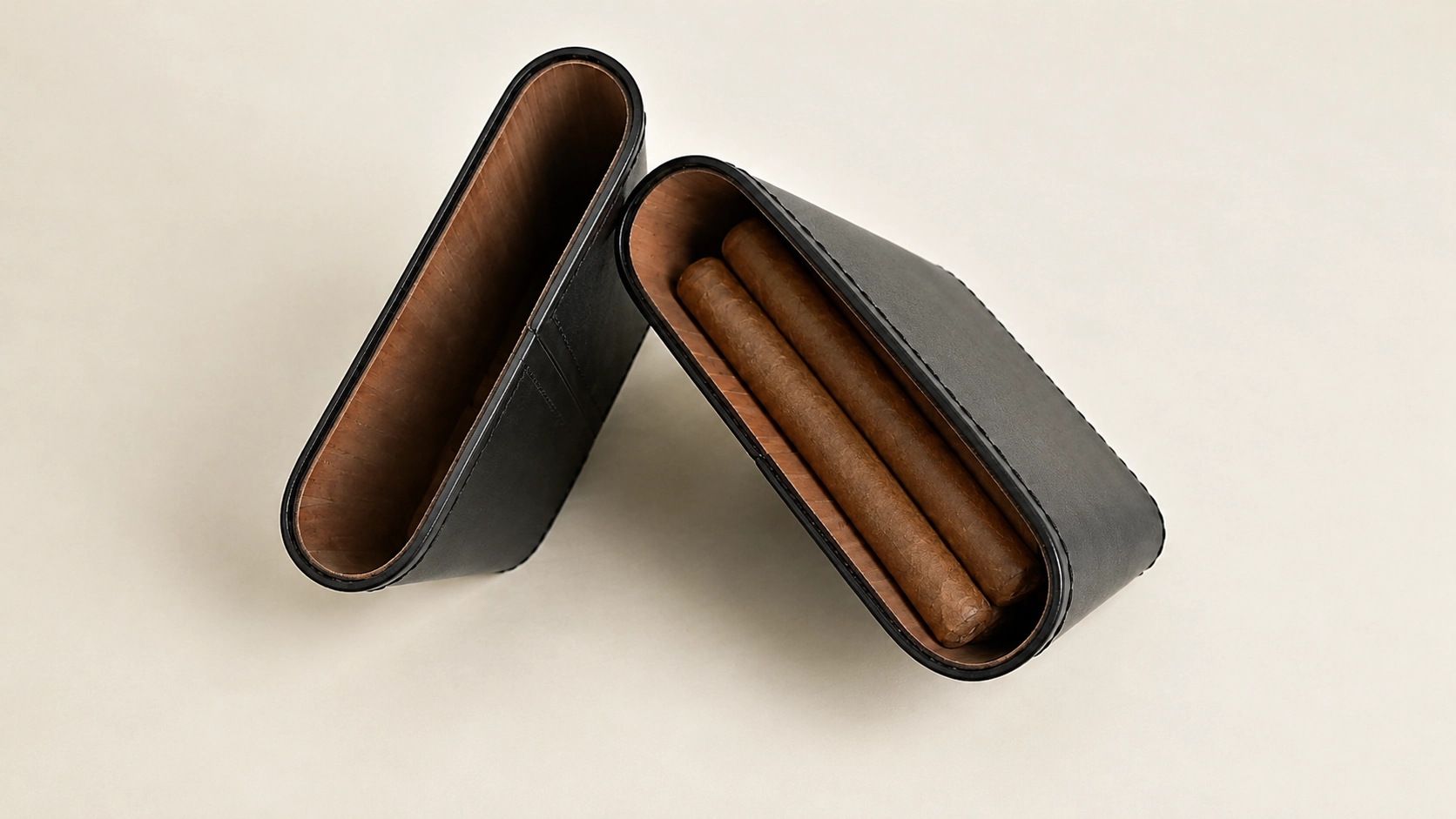
The closed case has an elongated rectangular profile with rounded corners and a relatively clean surface. Black leather covers the exterior, while visible stitching follows the outer edges and panel boundaries. The understated finish suits premium accessories, corporate gifting programmes, specialist retailers, and cigar-related product collections.
For development, the manufacturer should assess leather thickness, surface uniformity, corner wrapping, panel symmetry, and the relationship between the exterior covering and the rigid core. Excessively tight wrapping may cause surface distortion, while insufficient tension can create wrinkles or loose edges.
Open Case and Interior Structure
The open reference shows a warm brown interior and a rigid, elongated cavity. The design direction suggests a wood-lined construction rather than a soft leather pouch. This distinction is important because a wooden structure changes the product's weight, assembly method, edge treatment, and dimensional requirements.
The prototype should establish how the cigars sit inside the case, how much clearance is needed, and whether a divider or shaped insert is necessary. A close fit may improve organisation, but an overly tight cavity can make insertion and removal difficult or damage delicate wrappers.
Back Panel and Stitching
The rear view provides a reference for panel layout, seam placement, and the visual continuity of the exterior covering. Matching black thread is a suitable initial proposal for a discreet finish. A contrast thread can be evaluated separately if the buyer wants a more pronounced construction detail.
The back panel should be inspected for straight seams, balanced spacing, uniform stitch length, clean thread ends, and consistent leather tension. The approved sample should define which seams are decorative and which contribute to the construction.
3. Product Scope and Development Deliverables
The project scope should cover the steps required to move from a reference image to an approved product specification. The following deliverables are proposed for discussion and must be confirmed in the commercial quotation.
- Product brief: A written record of capacity, dimensions, intended use, materials, colour, and finish.
- Material selection: Evaluation of smooth black leather, wood or engineered structural material, interior lining, adhesives, and thread.
- Construction proposal: A documented approach to the rigid core, exterior covering, interior lining, and closure.
- Prototype development: A physical sample for assessing fit, appearance, usability, and construction.
- Sample review: A record of requested corrections and approved changes.
- Production specification: Confirmed dimensions, material references, workmanship criteria, and inspection points.
- Packaging proposal: Individual protection, optional gift packaging, and export-carton planning.
- Export coordination: Agreed shipment documentation, packing information, and country-of-origin marking arrangements.
Exalter Global Co. can discuss the leather-goods development requirements through its wider manufacturing and export operations. Feasibility, specialist woodworking arrangements, sampling charges, order quantities, and production schedules should be confirmed for this specific product before any commitment is made.
-
Sale!
RFID Protected Pull Strap Wallet for Cards & Cash
Original price was: $41.90.$15.19Current price is: $15.19.
You save -
Sale!
RFID Protected Pull Strap Leather Card Holder Wallet
Original price was: $41.90.$15.19Current price is: $15.19.
You save -
Sale!
RFID Protected Pull Strap Card Holder Wallet for Men Slim
Original price was: $41.90.$15.19Current price is: $15.19.
You save -
Sale!
RFID Protected Leather Card Holder Wallet for Men & Women
Original price was: $18.10.$6.39Current price is: $6.39.
You save -
Sale!
RFID Protected Pull Strap Card Holder Wallet for Secure Access
Original price was: $40.70.$14.79Current price is: $14.79.
You save -
Sale!
Slim RFID Protected Pull Strap Wallet for Cards & Cash
Original price was: $40.70.$14.79Current price is: $14.79.
You save -
Sale!
RFID Protected Pull Strap Card Holder Wallet for Daily Use
Original price was: $40.70.$14.79Current price is: $14.79.
You save -
Sale!
RFID Protected Card Holder Wallet for Secure Cards & Cash
Original price was: $27.30.$10.79Current price is: $10.79.
You save -
Sale!
RFID Protected Leather Card Holder Wallet with Slim Design
Original price was: $27.30.$10.79Current price is: $10.79.
You save -
Sale!
Slim RFID Protected Leather Card Holder Wallet for Cards
Original price was: $27.30.$10.79Current price is: $10.79.
You save -
Sale!
RFID Protected Leather Card Holder Wallet for Secure Cards
Original price was: $27.30.$10.79Current price is: $10.79.
You save -
Sale!
RFID Protected Genuine Leather Card Holder for Daily Use
Original price was: $27.30.$10.79Current price is: $10.79.
You save
-
Sale!
RFID Protected Pull Strap Wallet for Cards & Cash
Original price was: $41.90.$15.19Current price is: $15.19.
You save -
Sale!
RFID Protected Pull Strap Leather Card Holder Wallet
Original price was: $41.90.$15.19Current price is: $15.19.
You save -
Sale!
RFID Protected Pull Strap Card Holder Wallet for Men Slim
Original price was: $41.90.$15.19Current price is: $15.19.
You save -
Sale!
RFID Protected Leather Card Holder Wallet for Men & Women
Original price was: $18.10.$6.39Current price is: $6.39.
You save -
Sale!
RFID Protected Pull Strap Card Holder Wallet for Secure Access
Original price was: $40.70.$14.79Current price is: $14.79.
You save -
Sale!
Slim RFID Protected Pull Strap Wallet for Cards & Cash
Original price was: $40.70.$14.79Current price is: $14.79.
You save -
Sale!
RFID Protected Pull Strap Card Holder Wallet for Daily Use
Original price was: $40.70.$14.79Current price is: $14.79.
You save -
Sale!
RFID Protected Card Holder Wallet for Secure Cards & Cash
Original price was: $27.30.$10.79Current price is: $10.79.
You save -
Sale!
RFID Protected Leather Card Holder Wallet with Slim Design
Original price was: $27.30.$10.79Current price is: $10.79.
You save -
Sale!
Slim RFID Protected Leather Card Holder Wallet for Cards
Original price was: $27.30.$10.79Current price is: $10.79.
You save -
Sale!
RFID Protected Leather Card Holder Wallet for Secure Cards
Original price was: $27.30.$10.79Current price is: $10.79.
You save -
Sale!
RFID Protected Genuine Leather Card Holder for Daily Use
Original price was: $27.30.$10.79Current price is: $10.79.
You save
-
Sale!
RFID Protected Pull Strap Wallet for Cards & Cash
Original price was: $41.90.$15.19Current price is: $15.19.
You save -
Sale!
RFID Protected Pull Strap Leather Card Holder Wallet
Original price was: $41.90.$15.19Current price is: $15.19.
You save -
Sale!
RFID Protected Pull Strap Card Holder Wallet for Men Slim
Original price was: $41.90.$15.19Current price is: $15.19.
You save -
Sale!
RFID Protected Leather Card Holder Wallet for Men & Women
Original price was: $18.10.$6.39Current price is: $6.39.
You save -
Sale!
RFID Protected Pull Strap Card Holder Wallet for Secure Access
Original price was: $40.70.$14.79Current price is: $14.79.
You save -
Sale!
Slim RFID Protected Pull Strap Wallet for Cards & Cash
Original price was: $40.70.$14.79Current price is: $14.79.
You save -
Sale!
RFID Protected Pull Strap Card Holder Wallet for Daily Use
Original price was: $40.70.$14.79Current price is: $14.79.
You save -
Sale!
RFID Protected Card Holder Wallet for Secure Cards & Cash
Original price was: $27.30.$10.79Current price is: $10.79.
You save -
Sale!
RFID Protected Leather Card Holder Wallet with Slim Design
Original price was: $27.30.$10.79Current price is: $10.79.
You save -
Sale!
Slim RFID Protected Leather Card Holder Wallet for Cards
Original price was: $27.30.$10.79Current price is: $10.79.
You save -
Sale!
RFID Protected Leather Card Holder Wallet for Secure Cards
Original price was: $27.30.$10.79Current price is: $10.79.
You save -
Sale!
RFID Protected Genuine Leather Card Holder for Daily Use
Original price was: $27.30.$10.79Current price is: $10.79.
You save

4. Customer-Requested Materials and Their Suitability
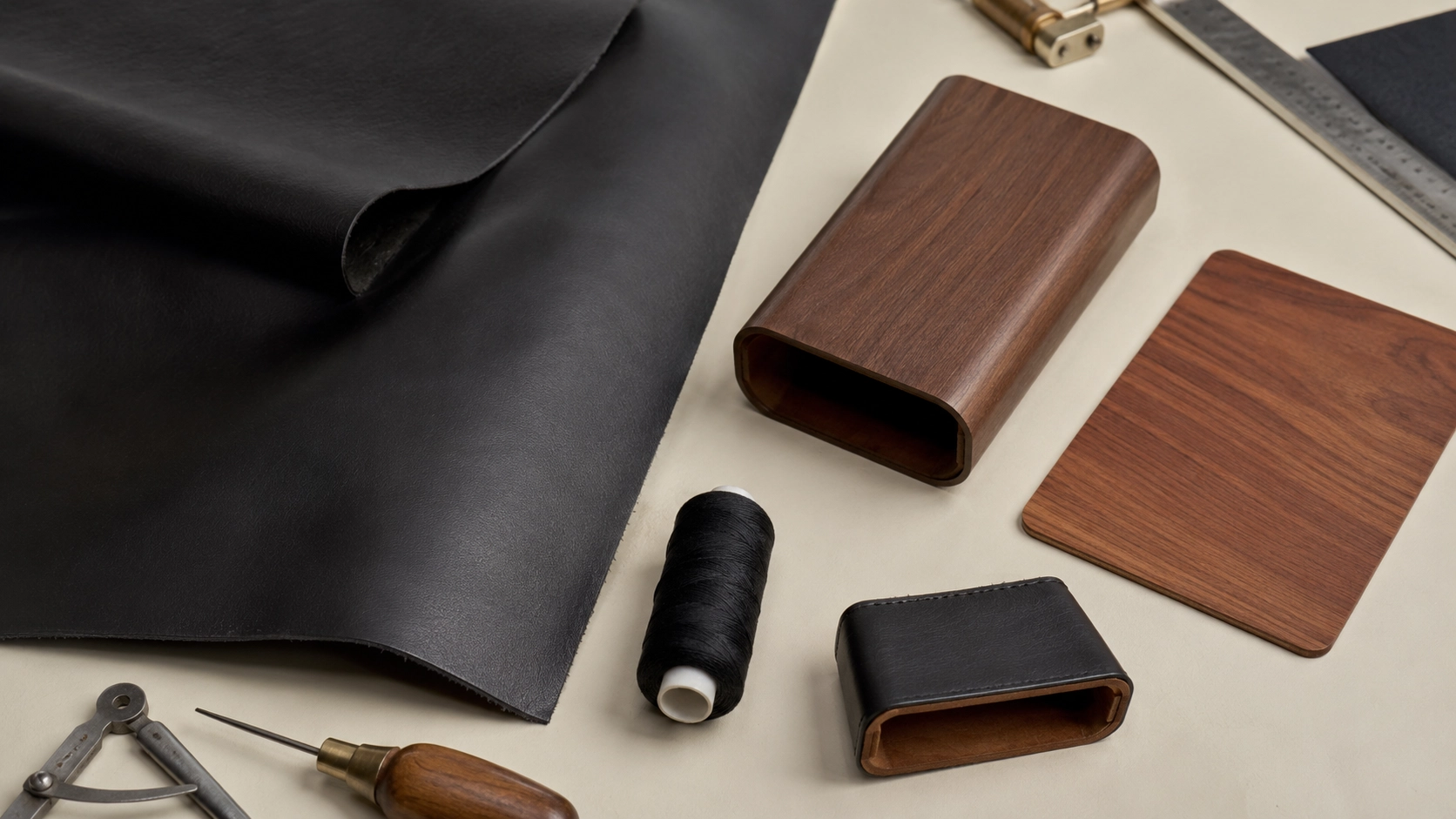
Material selection is central to this four-cigar case because the product combines a leather exterior with a rigid wooden structure. Each material must perform a defined function. The exterior contributes appearance and surface protection, the core maintains the shape, and the interior protects the contents from direct contact with hard structural edges.
Smooth Black Genuine Vegetable-Tanned Leather
The requested exterior material is smooth black genuine vegetable-tanned leather. Vegetable tanning uses tannins from plant sources and other suitable processing inputs to convert hides into leather. The resulting properties depend on the hide, tannage, finishing system, thickness, and subsequent treatment.
For this case, a smooth finish supports a restrained premium appearance. A suitable leather selection should balance surface consistency, flexibility around rounded corners, resistance to cracking during forming, and compatibility with the selected adhesive. The leather must wrap around the case without excessive stretching, visible creasing, or lifting at the edges.
Buyers should specify the desired leather grade, thickness range, finish, colour reference, and acceptable natural variation. Vegetable-tanned leather can develop patina and show variations in grain or shade. A black finish can reduce some visible variation, but it does not make every hide identical.
The buyer should also clarify whether the required material must be vegetable-tanned throughout or whether a specific surface finish is acceptable. A leather finish can influence appearance, flexibility, scratch visibility, and ageing. Material samples should therefore be reviewed under consistent lighting before approval.
Wooden Structural Core
The buyer has requested a case made of wood covered with smooth black leather. The wooden structure should provide the shape and rigidity of the case. It should also support reliable alignment between the two halves and help protect the contents from external pressure during normal handling.
The wood species has not been specified. A suitable species or engineered wood substrate should be selected only after evaluating weight, strength, machinability, moisture stability, availability, and the intended wall thickness. The selection should also consider the feasibility of producing smooth, rounded edges without weak points.
Wood moisture content, storage conditions, and surface preparation matter. Excess moisture variation can contribute to dimensional changes, while poor preparation can compromise adhesive bonding. The manufacturer should test the proposed substrate and adhesive combination before approving the construction method.
Where solid wood creates excessive weight or inconsistent dimensions, engineered wood may be considered as an alternative. However, it should not be substituted without the buyer's approval because the requested wooden construction may form part of the product's intended value proposition.
Interior Wood Lining
The reference images show a warm brown interior surface described as wood-lined. The final specification should distinguish between a genuine wood lining, a wood veneer, and a wood-look finish. These options are not materially equivalent and can differ in cost, durability, appearance, and sourcing requirements.
The interior must be smooth, free from splinters, and carefully finished around all edges. Any coating, adhesive, or treatment used inside the case should be assessed for odour transfer and suitability for the intended storage environment. Material compatibility should be confirmed rather than assumed.
A wood-lined case should not automatically be marketed as a humidity-controlled humidor. Wood lining alone does not establish reliable humidity regulation. If the buyer expects controlled humidity or extended cigar storage, additional design requirements and performance testing will be necessary.
Supporting Materials and Components
| Component | Proposed Selection | Key Consideration |
|---|---|---|
| Exterior leather | Smooth black genuine vegetable-tanned leather | Finish consistency, flexibility, colour, and bonding |
| Rigid core | Selected wood or approved engineered wood | Weight, strength, dimensional stability, and machining |
| Interior surface | Approved warm brown wood lining or veneer | Smoothness, odour, finish, and clean edges |
| Thread | Black matching thread | Abrasion resistance, stitch consistency, and colourfastness |
| Adhesive | Compatible leather-to-wood bonding system | Bond strength, curing, odour, and surface compatibility |
| Closure | To be selected during prototyping | Secure closure, alignment, wear, and ease of use |
These supporting materials are proposals, not confirmed specifications. The approved bill of materials should identify each component, its material description, supplier requirements, and any applicable testing criteria.
5. Proposed Technical Specifications
The supplied reference image includes a stated closed size of 188 x 123 x 32 mm. This can serve as an initial design reference, but it must be measured or independently confirmed before becoming a binding production specification. The stated capacity is four cigars.
| Specification | Initial Reference or Proposal | Confirmation Required |
|---|---|---|
| Capacity | Four cigars | Maximum cigar length and ring gauge |
| Closed dimensions | 188 x 123 x 32 mm, as stated in the reference | Actual sample measurements and dimensional tolerances |
| Exterior | Smooth black genuine vegetable-tanned leather | Leather grade, thickness, finish, and approved colour sample |
| Structure | Wooden core covered with leather | Wood species, wall thickness, and assembly method |
| Interior | Warm brown wood-lined finish | Lining material, coating, and cavity dimensions |
| Stitching | Black matching thread | Stitch length, thread specification, and seam placement |
| Closure | Suitable secure closure, to be determined | Mechanism, operating force, and cycle testing |
| Packaging | Protective individual packaging | Retail box, inserts, labels, and export-carton configuration |
The closed dimensions do not establish the usable interior capacity. Wall thickness, lining thickness, closure geometry, and internal separators all reduce available space. The manufacturer should confirm fit using representative cigars supplied or approved by the buyer.
6. Manufacturing Process: From Brief to Finished Sample
Step 1: Review the Product Brief
The process begins with a structured review of the reference images, target dimensions, required capacity, materials, intended price level, order quantity, and delivery expectations. The buyer should also identify the intended sales channel, such as specialist retail, gifting, or a broader accessories collection.
Any unresolved details should be recorded before quotation. This includes the exact wood construction, closure, internal layout, packaging, testing requirements, and whether the product will be sold as a standard cigar case or positioned for a specific storage purpose.
Step 2: Select and Approve Materials
Leather, wood, lining, thread, adhesive, and closure components should be evaluated together. A leather sample may look suitable on a flat surface but behave differently when wrapped around a rigid corner. Similarly, an adhesive that bonds well in a simple test may be unsuitable for a finished surface or enclosed interior.
Material approval should record the selected samples and acceptable variations. If a particular leather source or wood species is essential, it should be identified in writing and checked for availability before the development schedule is confirmed.
Step 3: Develop the Rigid Structure
The case core should be designed around the intended cigar capacity and closed dimensions. Both halves must align correctly, and the edges should provide adequate support for the leather covering. The design should account for the closure, seam placement, internal cavity, and the thickness of every lining layer.
At this stage, the team should evaluate whether the reference dimensions allow sufficient room for four cigars. If the capacity and exterior size conflict, the buyer must approve either a dimensional adjustment or a revised internal arrangement.
Step 4: Cut and Prepare the Leather
Leather panels should be cut using approved patterns that account for wrapping allowance, corner radii, seam placement, and edge finishing. The grain direction and visible surface quality should be considered when positioning each panel.
Careful preparation helps minimise wrinkles, uneven tension, and exposed core material. The leather should be checked for surface damage, inconsistent colour, and defects in areas that will remain visible after assembly.
Step 5: Assemble and Line the Case
The wooden core should be prepared and assembled to the approved dimensions. The interior lining should then be fitted with particular attention to smoothness, clean joints, and the absence of splinters or loose edges.
The exterior leather can be bonded and wrapped using the approved construction method. Any stitching should be completed according to the pattern and sample specification. The closure and two halves should be aligned before the assembly is accepted for finishing.
Step 6: Finish, Inspect, and Approve
After assembly, the case should undergo visual and functional inspection. Review the leather surface, edge finishing, stitching, internal lining, opening and closing action, and fit with representative cigars. Any corrections should be completed before the buyer approves the final sample.
The approved sample should become the reference for bulk production. Any later change to materials, dimensions, closure, or construction should be documented and approved rather than introduced informally.
-
Sale!
RFID Protected Pull Strap Wallet for Cards & Cash
Original price was: $41.90.$15.19Current price is: $15.19.
You save -
Sale!
RFID Protected Pull Strap Leather Card Holder Wallet
Original price was: $41.90.$15.19Current price is: $15.19.
You save -
Sale!
RFID Protected Pull Strap Card Holder Wallet for Men Slim
Original price was: $41.90.$15.19Current price is: $15.19.
You save -
Sale!
RFID Protected Leather Card Holder Wallet for Men & Women
Original price was: $18.10.$6.39Current price is: $6.39.
You save -
Sale!
RFID Protected Pull Strap Card Holder Wallet for Secure Access
Original price was: $40.70.$14.79Current price is: $14.79.
You save -
Sale!
Slim RFID Protected Pull Strap Wallet for Cards & Cash
Original price was: $40.70.$14.79Current price is: $14.79.
You save -
Sale!
RFID Protected Pull Strap Card Holder Wallet for Daily Use
Original price was: $40.70.$14.79Current price is: $14.79.
You save -
Sale!
RFID Protected Card Holder Wallet for Secure Cards & Cash
Original price was: $27.30.$10.79Current price is: $10.79.
You save -
Sale!
RFID Protected Leather Card Holder Wallet with Slim Design
Original price was: $27.30.$10.79Current price is: $10.79.
You save -
Sale!
Slim RFID Protected Leather Card Holder Wallet for Cards
Original price was: $27.30.$10.79Current price is: $10.79.
You save -
Sale!
RFID Protected Leather Card Holder Wallet for Secure Cards
Original price was: $27.30.$10.79Current price is: $10.79.
You save -
Sale!
RFID Protected Genuine Leather Card Holder for Daily Use
Original price was: $27.30.$10.79Current price is: $10.79.
You save
-
Sale!
RFID Protected Pull Strap Wallet for Cards & Cash
Original price was: $41.90.$15.19Current price is: $15.19.
You save -
Sale!
RFID Protected Pull Strap Leather Card Holder Wallet
Original price was: $41.90.$15.19Current price is: $15.19.
You save -
Sale!
RFID Protected Pull Strap Card Holder Wallet for Men Slim
Original price was: $41.90.$15.19Current price is: $15.19.
You save -
Sale!
RFID Protected Leather Card Holder Wallet for Men & Women
Original price was: $18.10.$6.39Current price is: $6.39.
You save -
Sale!
RFID Protected Pull Strap Card Holder Wallet for Secure Access
Original price was: $40.70.$14.79Current price is: $14.79.
You save -
Sale!
Slim RFID Protected Pull Strap Wallet for Cards & Cash
Original price was: $40.70.$14.79Current price is: $14.79.
You save -
Sale!
RFID Protected Pull Strap Card Holder Wallet for Daily Use
Original price was: $40.70.$14.79Current price is: $14.79.
You save -
Sale!
RFID Protected Card Holder Wallet for Secure Cards & Cash
Original price was: $27.30.$10.79Current price is: $10.79.
You save -
Sale!
RFID Protected Leather Card Holder Wallet with Slim Design
Original price was: $27.30.$10.79Current price is: $10.79.
You save -
Sale!
Slim RFID Protected Leather Card Holder Wallet for Cards
Original price was: $27.30.$10.79Current price is: $10.79.
You save -
Sale!
RFID Protected Leather Card Holder Wallet for Secure Cards
Original price was: $27.30.$10.79Current price is: $10.79.
You save -
Sale!
RFID Protected Genuine Leather Card Holder for Daily Use
Original price was: $27.30.$10.79Current price is: $10.79.
You save
-
Sale!
RFID Protected Pull Strap Wallet for Cards & Cash
Original price was: $41.90.$15.19Current price is: $15.19.
You save -
Sale!
RFID Protected Pull Strap Leather Card Holder Wallet
Original price was: $41.90.$15.19Current price is: $15.19.
You save -
Sale!
RFID Protected Pull Strap Card Holder Wallet for Men Slim
Original price was: $41.90.$15.19Current price is: $15.19.
You save -
Sale!
RFID Protected Leather Card Holder Wallet for Men & Women
Original price was: $18.10.$6.39Current price is: $6.39.
You save -
Sale!
RFID Protected Pull Strap Card Holder Wallet for Secure Access
Original price was: $40.70.$14.79Current price is: $14.79.
You save -
Sale!
Slim RFID Protected Pull Strap Wallet for Cards & Cash
Original price was: $40.70.$14.79Current price is: $14.79.
You save -
Sale!
RFID Protected Pull Strap Card Holder Wallet for Daily Use
Original price was: $40.70.$14.79Current price is: $14.79.
You save -
Sale!
RFID Protected Card Holder Wallet for Secure Cards & Cash
Original price was: $27.30.$10.79Current price is: $10.79.
You save -
Sale!
RFID Protected Leather Card Holder Wallet with Slim Design
Original price was: $27.30.$10.79Current price is: $10.79.
You save -
Sale!
Slim RFID Protected Leather Card Holder Wallet for Cards
Original price was: $27.30.$10.79Current price is: $10.79.
You save -
Sale!
RFID Protected Leather Card Holder Wallet for Secure Cards
Original price was: $27.30.$10.79Current price is: $10.79.
You save -
Sale!
RFID Protected Genuine Leather Card Holder for Daily Use
Original price was: $27.30.$10.79Current price is: $10.79.
You save

7. Customisation Options for US Buyers
A custom leather cigar case can be developed around a buyer's preferred appearance, functional requirements, price point, and retail positioning. Customisation should be controlled through a written specification so that material changes do not compromise fit, construction, or repeatability.
| Customisation Area | Available Development Direction |
|---|---|
| Leather finish | Smooth black, subject to approved leather availability |
| Exterior colours | Alternative colours can be evaluated as separate material options |
| Interior finish | Warm brown wood, approved veneer, or another agreed lining |
| Capacity | Four-cigar configuration, with fit confirmed against actual cigar dimensions |
| Dimensions | Adjusted to the intended cigar format and portability requirements |
| Stitching | Matching black thread or a separately approved contrast colour |
| Closure | A practical mechanism selected and tested during prototyping |
| Packaging | Protective packaging, presentation boxes, and approved retail packaging |
These are potential options rather than confirmed features of the supplied design. Each variation may affect tooling, material procurement, production time, minimum order quantity, and unit cost. Buyers should request separate quotations when comparing materially different constructions.
8. Quality Control and Product Acceptance
Quality control should focus on measurable criteria rather than general descriptions such as premium or export quality. The buyer and manufacturer should agree on acceptable workmanship, functional tests, and inspection procedures before bulk production.
Recommended Inspection Checklist
- Leather: Check colour consistency, smoothness, visible defects, wrinkles, and surface damage.
- Structure: Inspect the rigid core for cracks, deformation, loose components, and dimensional inconsistencies.
- Interior: Check for splinters, rough edges, loose lining, visible adhesive, and unacceptable odour.
- Stitching: Verify seam alignment, consistent stitch length, secure thread ends, and the absence of skipped stitches.
- Closure: Open and close the case repeatedly to assess alignment, secure engagement, and wear.
- Capacity: Confirm that four representative cigars fit without excessive compression or difficult removal.
- Dimensions: Measure the closed case and internal cavity against the approved drawing and tolerances.
- Bonding: Check for lifting leather, loose corners, gaps, and separation at material junctions.
- Packaging: Verify surface protection, carton strength, product identification, and packing quantities.
Testing should reflect the intended use. If the case is expected to protect cigars against specific impacts, pressure, temperature changes, or humidity conditions, those expectations need separate acceptance criteria and appropriate testing. They should not be inferred from appearance alone.
A written inspection record can include the sample reference, measurement results, defects identified, corrective actions, and approval status. For larger orders, buyers may consider an independent pre-shipment inspection. The sampling plan and acceptance limits should be agreed before inspection begins.
9. Challenges and Proposed Solutions
| Potential Challenge | Recommended Response |
|---|---|
| Leather wrinkles around rounded corners | Refine panel patterns, wrapping allowances, leather selection, and assembly technique. |
| Four cigars do not fit comfortably | Confirm cigar length and ring gauge, then revise the cavity or external dimensions. |
| Wood movement affects alignment | Control material conditioning, select a suitable substrate, and inspect assembly tolerances. |
| Adhesive creates odour or weak bonding | Evaluate compatible materials, curing conditions, and the finished assembly before approval. |
| Leather colour varies between batches | Approve a colour reference, define reasonable tolerances, and assess natural variation. |
| Cost exceeds the target price | Compare approved structural, lining, packaging, and material alternatives without compromising essential performance. |
| Export documentation is incomplete | Confirm product descriptions, origin information, packing details, and responsibilities before dispatch. |
10. United States Market and Import Considerations
The United States is the intended destination market for this project. Product design should reflect the buyer's commercial positioning and end-user expectations, while regulatory obligations should be assessed separately. A premium appearance or a US sales destination does not automatically create a specific legal requirement for the product's dimensions, leather finish, or interior construction.
Country-of-Origin Marking
US Customs and Border Protection explains that imported articles generally require country-of-origin marking, subject to applicable exceptions. Marking must satisfy the relevant requirements for visibility, legibility, and permanence. The appropriate method and location depend on the product and applicable rules.
The importer and exporter should confirm the marking requirements for the final article and packaging before production. The country of origin must reflect the applicable origin determination; the intended US market does not mean the item is made in the United States. Review the official US Customs and Border Protection importing guidance and obtain transaction-specific advice where necessary.
Leather Claims and Material Descriptions
Product descriptions should accurately distinguish genuine leather from imitation leather and disclose material composition where required. The US Federal Trade Commission's Leather Guides address potentially misleading claims about leather and simulated leather products.
For this project, the buyer should retain records supporting claims about genuine leather, vegetable tanning, wood species, and interior materials. Claims about certified sourcing or specialised performance should only be made when supported by relevant documentation.
Wood and Import Documentation
Because the proposed case includes wood, the importer should confirm the applicable requirements based on the wood species, processing, country of origin, and final product classification. The precise requirements cannot be determined from the reference images alone. Where relevant, the parties should check whether declarations, treatment records, or additional documentation apply to the chosen materials.
The importer should also confirm the product's tariff classification, applicable duties, entry requirements, and any additional agency requirements with a qualified customs broker or the relevant US authority. These details should not be assumed from the product name alone.
11. OEM, Private-Label, and Export Development with Exalter Global Co.
Exalter Global Co. operates from Kolkata, India, and serves international buyers through its wider manufacturing and export business. For a project such as this, the initial commercial discussion should establish whether the required wooden construction and leather covering can be developed within the company's available or coordinated supply chain.
Potential support may include reviewing the product brief, discussing leather options, coordinating sample development, documenting approved specifications, evaluating custom packaging, and planning export requirements. Specialist woodworking, testing, and other external services should be confirmed individually rather than assumed to be available in-house.
Buyers can explore Exalter Vachette's leather goods and custom product offering for broader context on the company's leather business. The official sales and export trading conditions explain commercial matters such as sampling, material sourcing, production prerequisites, inspection, packaging, and shipping.
Exalter Vachette and Brooklyn Bridge are relevant brand references within the wider leather goods business. Any cigar case produced for either brand or for an external customer would require separate product approval and a confirmed commercial arrangement. The supplied reference images do not establish that this particular case has been manufactured, sold, or commissioned by either brand.
Suggested Buyer-to-Manufacturer Workflow
- Submit the brief: Share reference images, required capacity, dimensions, materials, order quantity, and target price.
- Review feasibility: Confirm structural requirements, material availability, and the scope of specialist work.
- Obtain a quotation: Request a written breakdown of sampling, production, packaging, testing, and export-related costs.
- Approve the sample: Check dimensions, cigar fit, leather finish, interior construction, closure, and workmanship.
- Confirm the order: Approve the final specification, order quantity, delivery schedule, and applicable commercial terms.
- Inspect production: Apply agreed quality checks and resolve deviations before shipment.
- Coordinate export: Finalise packaging, shipping documents, origin marking, and the agreed delivery arrangement.
Exalter Global Co.'s published trading conditions state a standard minimum order quantity of 100 pieces per colour, style, or design for the products covered by those terms. This should not be treated as automatic confirmation of the MOQ for a new wooden cigar case. The actual minimum, tooling costs, and lead time require a product-specific quotation.
12. Buyer Checklist Before Requesting a Quotation
- Confirm whether the reference dimensions of 188 x 123 x 32 mm are mandatory.
- Provide the maximum cigar length and ring gauge for the intended four-cigar capacity.
- Confirm the exact leather specification, including vegetable tanning and smooth black finish.
- Identify the required wood species or approve a proposed alternative.
- Specify whether the interior must use solid wood, veneer, or another approved finish.
- Confirm the closure type and any requirements for repeated opening and closing.
- State the target order quantity, estimated repeat-order volume, and target unit cost.
- Identify the packaging format and any retail presentation requirements.
- Confirm US destination, importer responsibilities, origin marking, and applicable testing.
- Agree on sample approval, inspection criteria, payment terms, and shipment conditions.
13. Frequently Asked Questions
What is involved in manufacturing a custom leather cigar case?
The process involves defining the product brief, selecting leather and structural materials, developing the internal cavity, producing a prototype, testing fit and closure, approving the sample, and manufacturing against written quality criteria. Packaging and export requirements should also be agreed before production.
Can a four-cigar case be made with a wooden core and black leather exterior?
That construction can be evaluated as a custom product concept. The selected wood, leather thickness, adhesive, lining, and assembly method must be compatible. A prototype is needed to establish practical feasibility and final dimensions.
Is vegetable-tanned leather suitable for a premium cigar case?
Smooth vegetable-tanned leather can provide a refined exterior when its thickness, flexibility, finishing, and colour are appropriate for the design. The finished product should be tested for corner wrapping, surface quality, bonding, and expected wear.
Does a wood-lined cigar case control humidity?
Not necessarily. A wood lining alone does not establish humidity control. A product intended to maintain specific humidity conditions requires additional design considerations and suitable performance testing.
What dimensions are shown in the supplied reference?
The reference description states a closed size of 188 x 123 x 32 mm and a capacity of four cigars. These measurements should be independently confirmed before production, along with the internal cavity dimensions and compatible cigar sizes.
Can Exalter Global Co. develop this product for a US buyer?
Exalter Global Co. can discuss the requirements as a proposed custom manufacturing and export project. The feasibility of the rigid wooden construction, sample development, material sourcing, minimum order quantity, testing, and production schedule must be confirmed before the company commits to the project.
What should a buyer provide to receive an accurate quotation?
Provide reference images, confirmed dimensions, cigar measurements, leather and wood requirements, quantity, packaging preferences, target price, destination, and any testing or documentation requirements. These details help the manufacturer identify cost drivers and prepare a more meaningful proposal.
Conclusion: Turning a Product Reference into a Manufacturing Specification
The four-cigar case is a useful example of how a product image can become a structured manufacturing brief. Its defining requirements are a smooth black genuine vegetable-tanned leather exterior, a wooden structure covered with leather, a warm brown interior direction, and capacity for four cigars.
The next step is to validate dimensions, confirm materials, assess the construction method, and develop a physical sample. Once the buyer approves the sample and acceptance criteria, the manufacturer can finalise the production specification and export plan.
For US importers, distributors, specialist retailers, and private-label buyers, clear specifications and documented approvals are essential to managing product consistency and commercial risk. Exalter Global Co. can review the proposed brief and discuss the feasibility of developing this product through its leather goods and export operations.
To discuss a custom leather cigar case project, visit Exalter Global Co. and submit the proposed capacity, materials, dimensions, order quantity, and destination requirements for an initial review.

-
Sale!
RFID Protected Pull Strap Wallet for Cards & Cash
Original price was: $41.90.$15.19Current price is: $15.19.
You save -
Sale!
RFID Protected Pull Strap Leather Card Holder Wallet
Original price was: $41.90.$15.19Current price is: $15.19.
You save -
Sale!
RFID Protected Pull Strap Card Holder Wallet for Men Slim
Original price was: $41.90.$15.19Current price is: $15.19.
You save -
Sale!
RFID Protected Leather Card Holder Wallet for Men & Women
Original price was: $18.10.$6.39Current price is: $6.39.
You save -
Sale!
RFID Protected Pull Strap Card Holder Wallet for Secure Access
Original price was: $40.70.$14.79Current price is: $14.79.
You save -
Sale!
Slim RFID Protected Pull Strap Wallet for Cards & Cash
Original price was: $40.70.$14.79Current price is: $14.79.
You save -
Sale!
RFID Protected Pull Strap Card Holder Wallet for Daily Use
Original price was: $40.70.$14.79Current price is: $14.79.
You save -
Sale!
RFID Protected Card Holder Wallet for Secure Cards & Cash
Original price was: $27.30.$10.79Current price is: $10.79.
You save -
Sale!
RFID Protected Leather Card Holder Wallet with Slim Design
Original price was: $27.30.$10.79Current price is: $10.79.
You save -
Sale!
Slim RFID Protected Leather Card Holder Wallet for Cards
Original price was: $27.30.$10.79Current price is: $10.79.
You save -
Sale!
RFID Protected Leather Card Holder Wallet for Secure Cards
Original price was: $27.30.$10.79Current price is: $10.79.
You save -
Sale!
RFID Protected Genuine Leather Card Holder for Daily Use
Original price was: $27.30.$10.79Current price is: $10.79.
You save